Leading a 20-person controls & firmware team on a Formula SAE electric race car
I lead the group behind the car's electronics: ECU architecture, telemetry, HIL/SIL test
infrastructure, and vehicle control logic. My focus this year has been making the firmware testable so
we can improve code coverage and catch bugs before they reach the car.
Rethinking the SIL abstraction
Our hardware-abstraction layer had grown so broad that it worked against us: the old idea was that
all code should be platform-agnostic, which pushed IO so far from the application that we couldn't use
STM32 timers or interrupts where we needed them. I rescoped it so SIL tests one task at a time, sitting between
unit tests and HIL, rather than mocking the whole system at once.
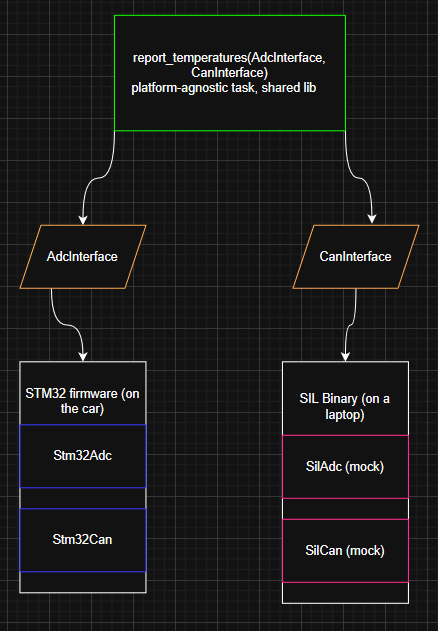
A task takes abstract peripheral interfaces; STM32 and SIL each supply their own implementation.
The mechanism: dependency injection
The old pattern had tasks reach out to global bindings:: peripherals directly, tying
every task to one board and making it impossible to substitute mocks for SIL. I moved the boundary to dependency
injection: a task takes its peripherals and shared resources as arguments, so the same code runs on the STM32 with
real drivers or in a SIL binary with mocks.
// BEFORE — task reaches for global bindings, hard-wired to one board
void task_10hz() {
    float v1 = bindings::suspension_travel1.ReadVoltage();  // global
    bindings::veh_can.Send(TxSuspensionTravel12{...});         // global
}

// AFTER — dependencies injected; runs on STM32 or in SIL  (racecar #529)
void ReadAndSendTemperatures(float update_period_ms, VehBus& veh_can_bus,
        FanController& fan_controller,
        etl::array<TempSensor, kSensorCount>& temp_sensors);
CAN Telemetry & Data Acquisition
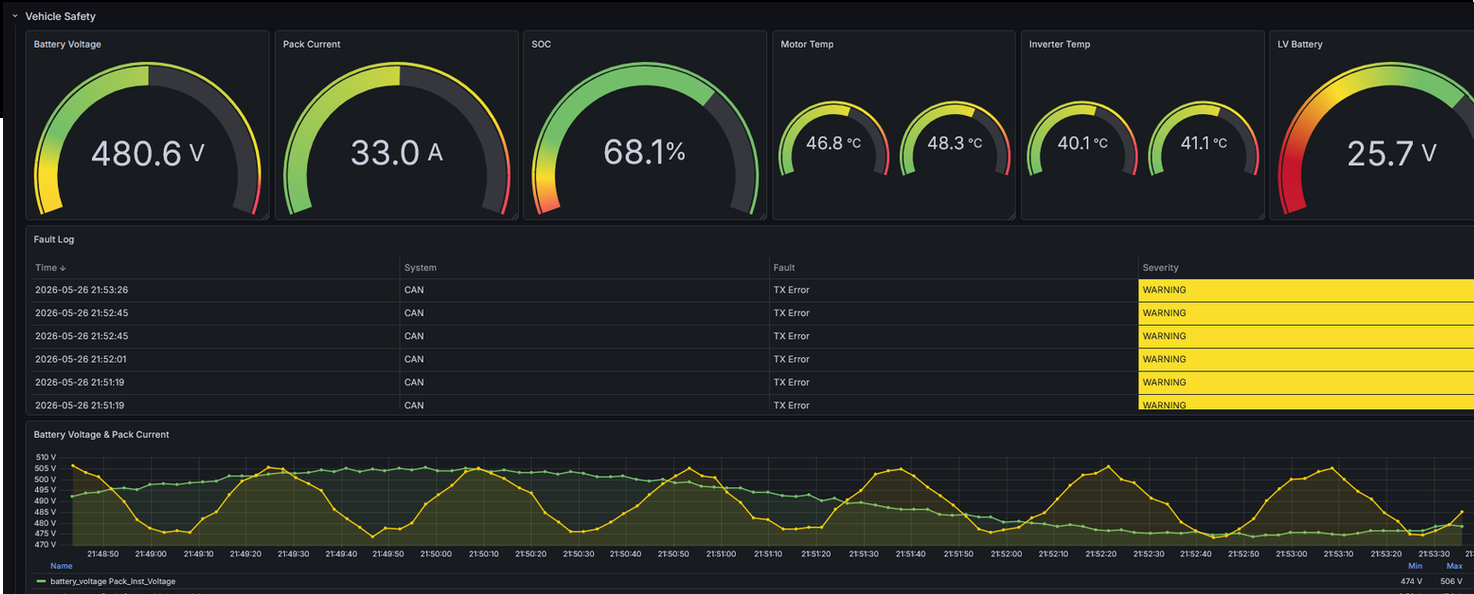
I built a Raspberry Pi-based system that turns live CAN traffic into usable telemetry during
testing while keeping a complete local record on an SSD.

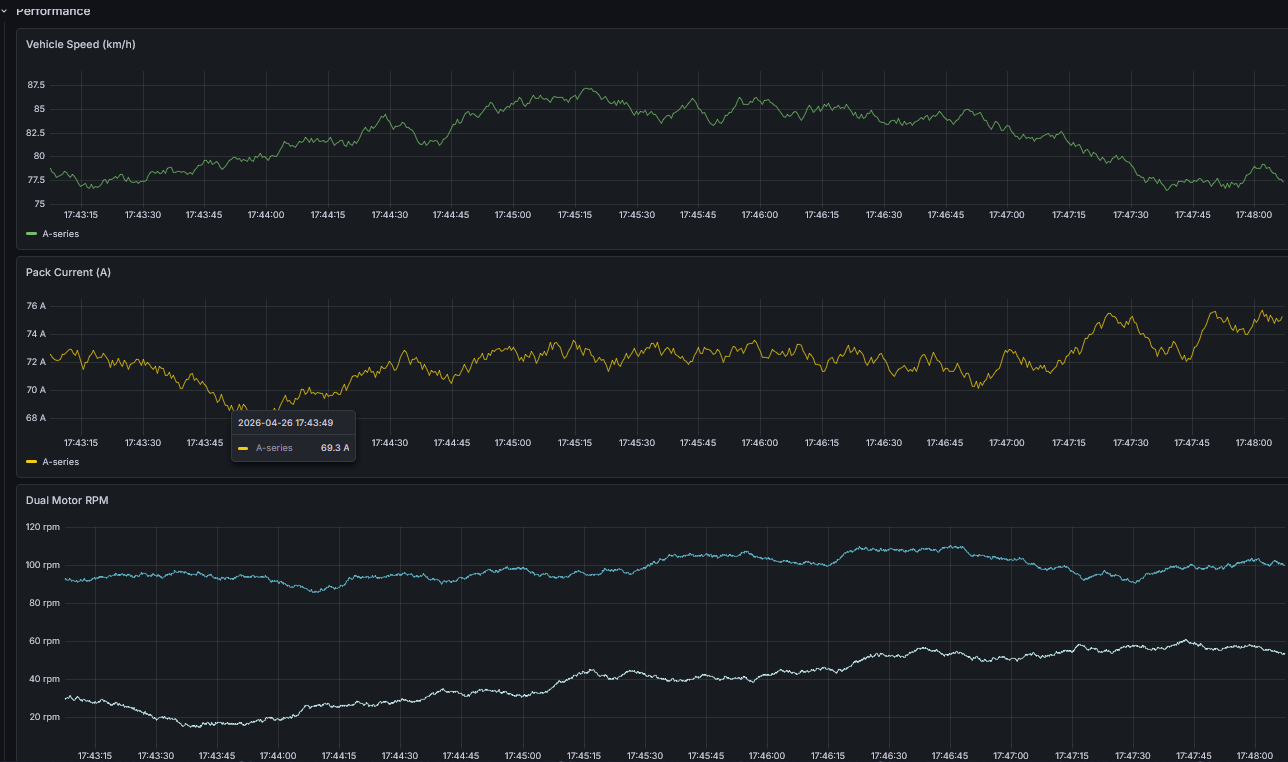
CAN frames flow through DBC decoding, local storage, InfluxDB, and Grafana.
- Decodes vehicle and powertrain messages using our DBC files, including speed, pedal position, suspension
travel, motor speed, inverter temperatures, battery data, IMU measurements, and system faults.
- Streams selected signals and threshold-based alerts to InfluxDB for live Grafana dashboards.
- Records decoded data continuously to the local SSD, preserving a reliable dataset if the wireless connection
drops.
- The Pi hosts its own Wi-Fi network, providing dashboard access within range without relying on external
network infrastructure.
Dashboard views for live vehicle signals and fault monitoring.
CAN Flash Bootloader (OTA firmware updates)
Currently building. Reflashing an ECU used to mean physically reaching a board buried in the
chassis and connecting a programmer. I'm building an over-the-air path instead: a Raspberry Pi pushes firmware to
any ECU over the CAN bus the car already runs.
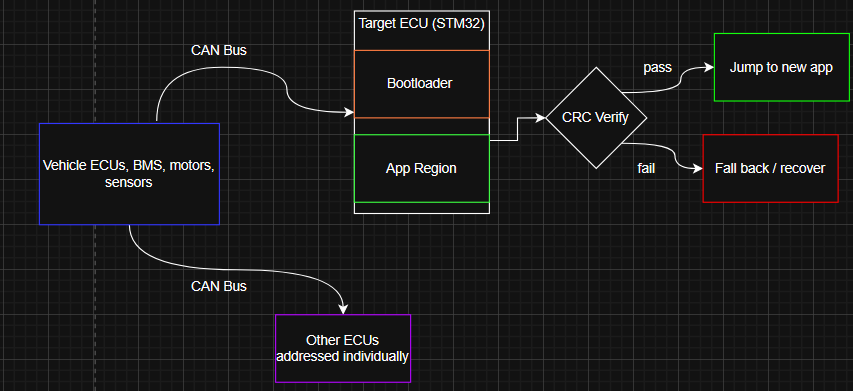
A resident bootloader on each ECU receives the image over CAN and reflashes the app in place.
- Each STM32 ECU carries a resident bootloader that writes the received image to the app flash region.
- ECUs are addressed individually on the bus, and each image is CRC-verified before the ECU jumps to the new
app.
HIL Controller Sequences
In progress. SIL proves the logic; HIL proves the firmware on real hardware. I'm writing
controller sequences that run the ECUs against simulated vehicle IO on our HIL rig, so we validate behaviour
before anything touches the car.
Embedded Systems Co-op, Ciena
Developing firmware for automated testing and designing analog circuitry for optical hardware,
Ottawa ON
My work centred on validating hardware faster. I built a menu-driven ATE framework that follows a
board from prototype through production: my firmware runs on a Raspberry Pi and drives a test board that plugs
into a machine exercising the real production boards.
- Wrote the I2C, SPI, and PCIe drivers the framework relied on, and validated them on the bench with an
oscilloscope and logic analyzer.
- Designed and validated a dedicated fan-tachometer measurement circuit that produced more accurate RPM
readings than software pulse counting on the Raspberry Pi.
- Delivered a schematic and layout uprev of an analog control board in Cadence to close out existing design
issues.
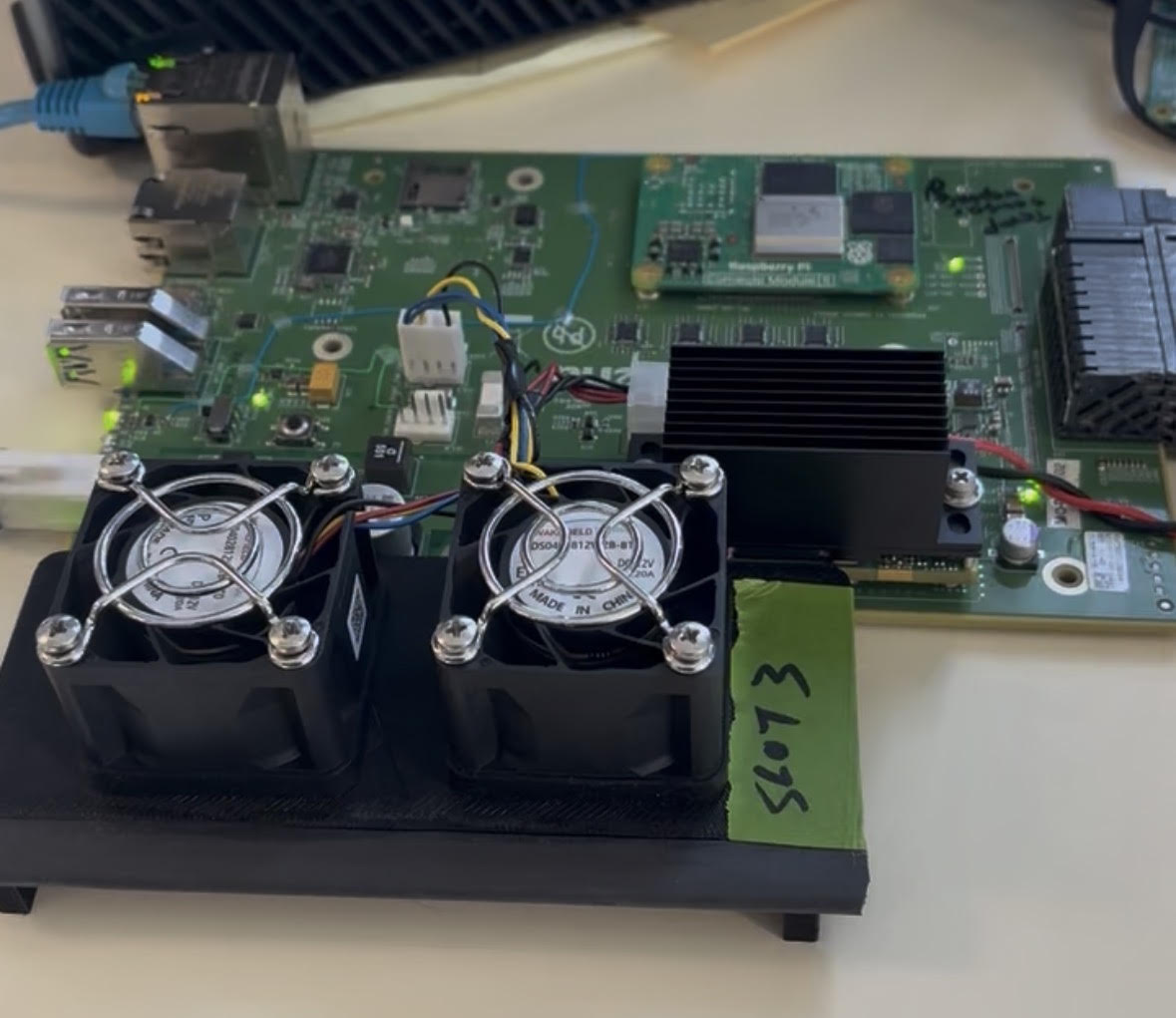
Fan-RPM test fixture used to validate the dedicated tachometer measurement circuit.
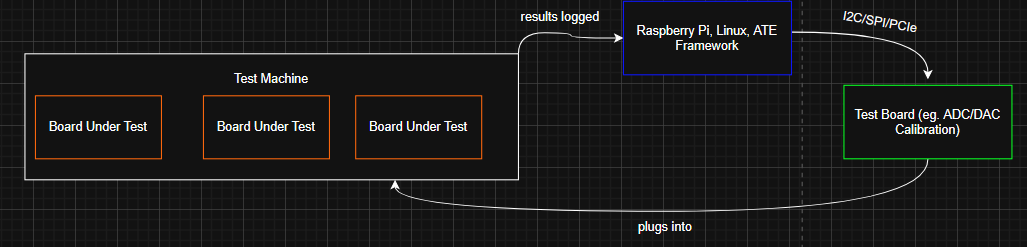
Pi-hosted firmware drives a test board connected to the hardware under test.
Embedded Software Co-op, Lumatone
Firmware and real-time tooling for a digital instrument, Toronto ON
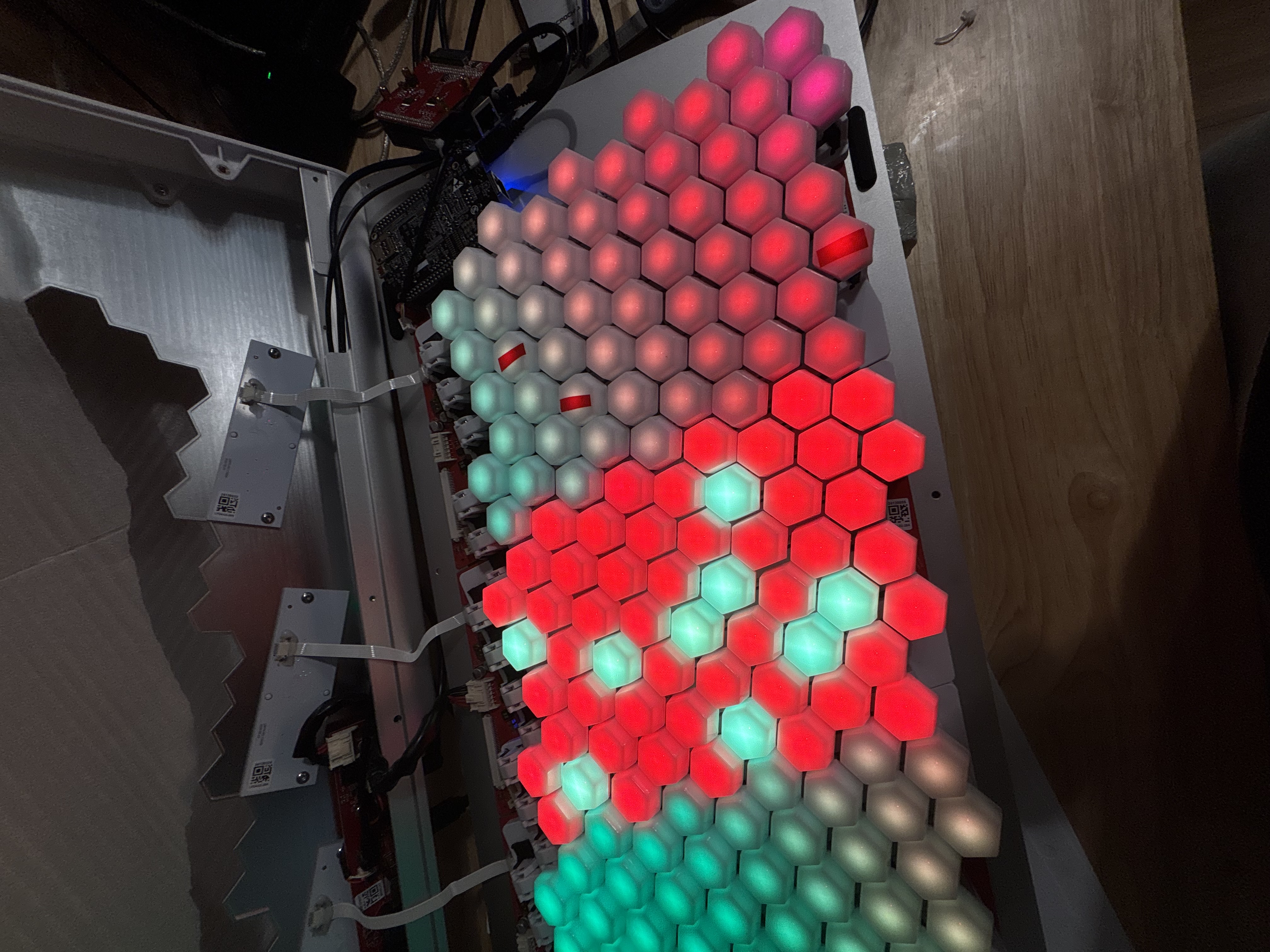
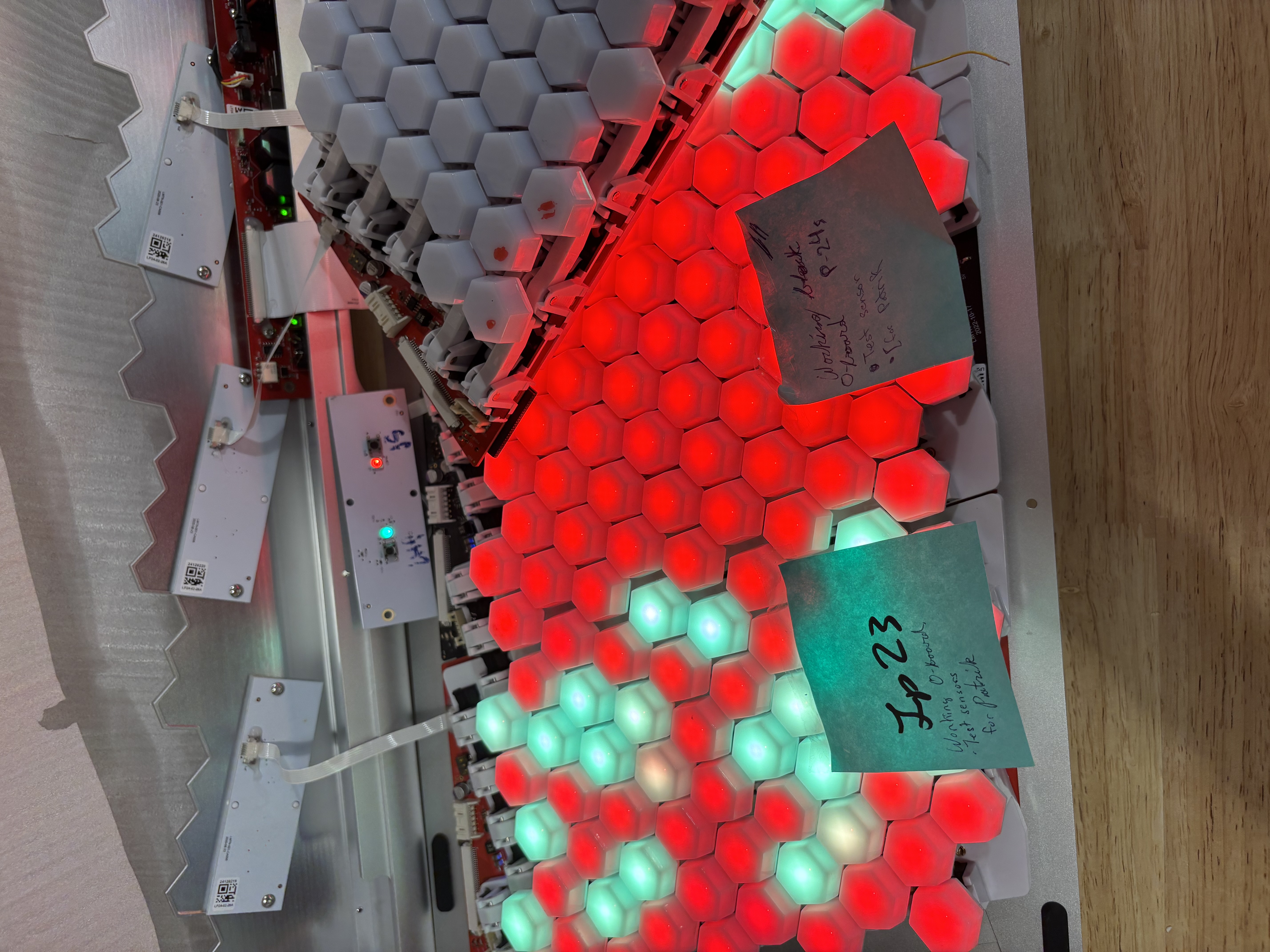
A faulty hall-effect sensor or a misaligned assembly could pass initial checks and only fail later
in QA. I wanted those caught the moment a unit was built, so I wrote a C test sequence that streams live sensor
data straight to the assembler.
- The sequence runs on the BeagleBone, continuously polling the hall-effect sensor ADCs and pushing readings
into a real-time Matplotlib view.
- Watching the live signal, an assembler can spot a weak sensor or a bad mechanical fit on the spot, with no
manual log review.
- Used during hardware bring-up to surface faulty readings quickly and cut time spent on QA and calibration.
Live hall-effect sensor readout used on the assembly line.
USB-to-CAN Adapter
Personal project, STM32 hardware and firmware
I designed my own adapter end
to end, board and firmware, and owned the full bring-up loop
- STM32-based PCB in Altium with USB-C, a CAN transceiver, power regulation, switchable termination, and ESD
protection.
- Embedded C firmware for USB/CAN communication with configurable message filtering.
- Hardware debug and programming interfaces (SWD, status indicators) built in for bring-up.
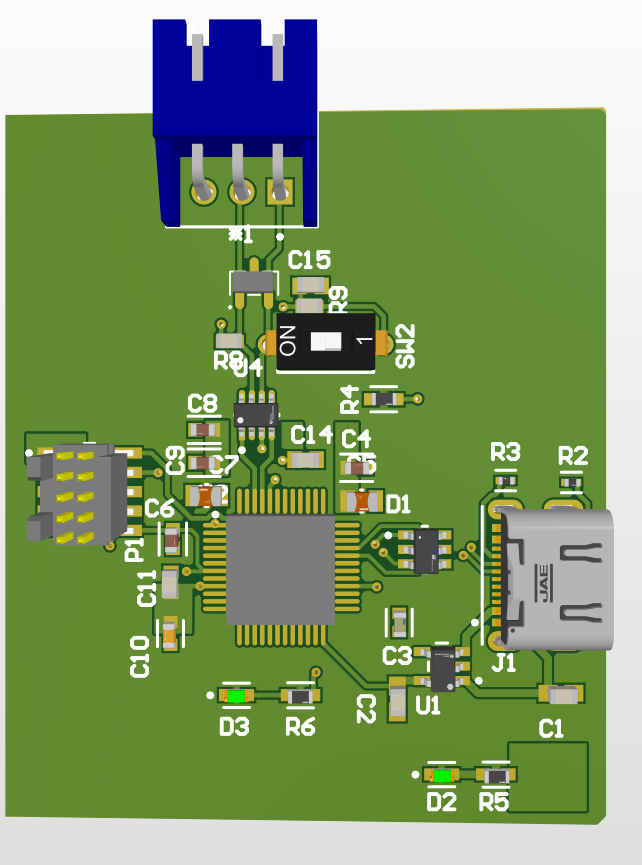
Assembled STM32-based USB-to-CAN adapter board (Altium).
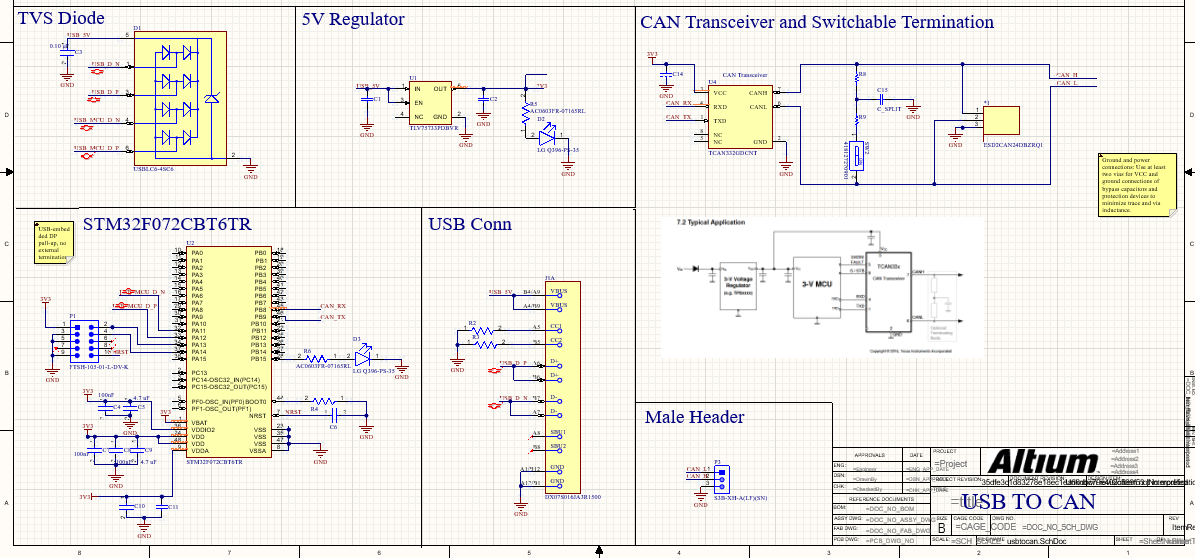
Schematic: USB-C, CAN transceiver with switchable termination, power regulation, and header.
Low-Voltage Battery Management System (LV BMS)
STM32 firmware, Formula Electric vehicle
The LV BMS sits in the car's safety chain: it monitors cell voltages and enforces the constraints
that decide whether the vehicle can run. Because it's safety-critical, I built the firmware around defensive,
deterministic behaviour rather than clever features.
- The board talks to the battery-monitoring hardware over SPI, which offers no corruption protection, so I put a
CRC / Packet Error Code (PEC) on every frame.
- Incoming frames are validated by recomputing the CRC against the received PEC, and any mismatch is rejected
before it reaches safety-critical logic.
- Protocol, command codes, and application logic live in separate modules, keeping the system straightforward to
debug and extend.

LV Controller to LV BMS over SPI; LV BMS to LV Battery through an ISOSPI transceiver.